Fair shuffle
Provably Fair Blackjack: A Shuffle You Can Check Yourself
Every online card game asks you to trust its shuffle. BlackJack Streak doesn't. Before a shoe is dealt, the dealer's secret is sealed with a fingerprint you can see. Your own browser adds randomness the server can't predict. And when the shoe is done, everything is opened up, so you can check that every card you were dealt came off the top, in order, exactly as promised.
Why a fair shuffle needs proof, not promises
In most online card games the shuffle happens on a server you never see. You're told it's random, and you're asked to take that on trust. When you hit a bad run, there's no way to tell bad luck from a bad shuffle, and that doubt spoils the game.
Provably fair turns it around. The game commits to the shuffle before you play, in a way it can't quietly change later, and proves it afterwards. You don't have to trust BlackJack Streak. You can check it. If you're wondering whether other games are rigged, we've written a separate guide on how to tell if online blackjack is rigged.
How the BlackJack Streak shuffle works
Nobody can choose the order of the cards: not Frank, not another player, and not whoever runs the server. Here's how, in seven steps.
1. The dealer commits first
Before a shoe is shuffled, the server draws a secret 256-bit seed from its cryptographic random number generator and publishes its SHA-256 fingerprint. Think of it as a sealed envelope on the table: you can't read what's inside, but if anyone swaps the contents later, the seal won't match. You can see the fingerprint in the Fair shuffle panel before the shoe is used.
2. You add a seed of your own
Your browser makes its own random seed and sends it in, and so does everyone else at the table. The server can't know those seeds when it commits, and the players never see the dealer's seed until afterwards. Neither side can steer the result, because neither side knows the other's half.
3. A fair algorithm
The shoe is shuffled with Fisher-Yates, the standard way to shuffle a list so every order is possible, driven by SHA-256 of all the seeds together. It uses rejection sampling, which means every possible ordering of the shoe is exactly as likely as any other, with no modulo bias (a common shortcut in shuffling code that makes some positions slightly more likely than others). Cards then come strictly off the top.
4. Opened afterwards
When a shoe is retired, the panel reveals the dealer's seed, checks it against the fingerprint published before the shuffle, recomputes the whole order of the shoe, and confirms that every card you saw dealt came off the top in that order, and that your own seed was part of it.
5. The proof is yours to keep
You can copy the complete proof from the panel: the seeds, the fingerprint and the order. The check is built on standard SHA-256, so it doesn't depend on trusting what our screen tells you.
6. Secrets stay secret
Frank's face-down card is never sent to anyone's browser until it's turned over, so nobody can peek at it. The shuffle never sees bets, balances or decisions. It can't know whether you bet 5,000 or a million.
7. Test the shuffler yourself
The panel can run 100,000 seeded shuffles on the spot and chart where the Ace of Spades lands. A fair shuffler spreads it evenly across every position in the shoe, and you can watch it do so.
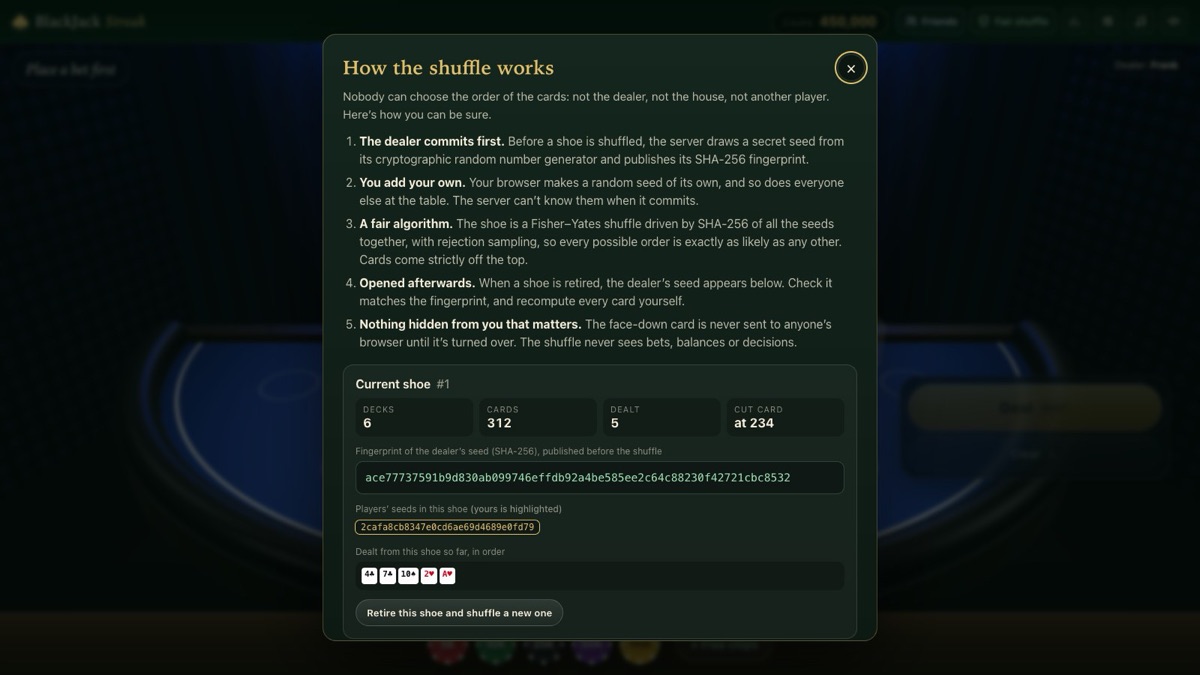
What you'll find in the Fair shuffle panel
Click the green shield marked Fair shuffle at the top of the table. You'll see:
- The current shoe: how many decks, how many cards, how many have been dealt, and where the cut card sits.
- The fingerprint of the dealer's seed (SHA-256), published before the shuffle.
- The players' seeds in this shoe, with yours highlighted.
- Every card dealt from this shoe so far, in order.
- The previous shoe, opened up, with a verdict on whether everything matched.
- The next shoe: its fingerprint is fixed before it's ever shuffled, next to your own seed, which you can swap for a new one with Make me a new seed.
You can also click the shoe tag on the table to see the sealed fingerprint of the shoe in play. Frank, for his part, is happy to point you there:
Frank says
“If you ever wonder whether I'm rigging the cards, click that little shield up top. It's the proof. I've got nothing to hide but my bald spot.”
Check a shoe yourself, step by step
- Play a few hands at BlackJackStreak.com. No account needed.
- Open Fair shuffle and note the first few characters of the current shoe's fingerprint.
- Retire the shoe. Press Retire this shoe and shuffle a new one, or keep playing until the cut card comes out.
- Look at the previous shoe. Its seed is now revealed. Check that the fingerprint is the one you noted, that the verdict says it matches, and that your seed is listed.
- Run the shuffler test and watch where the Ace of Spades lands over 100,000 shuffles.
What provably fair does, and doesn't, promise
Provably fair proves the cards are honest. It doesn't make them friendly. Blackjack still has a small built-in house edge, because you act first and a bust loses even if the dealer busts later. At BlackJack Streak's default rules, perfect basic strategy leaves the house an edge of about 0.38%, which we measured over 98 million simulated rounds through the game's own rules engine.
It also means streaks are real and normal. Losing five rounds in a row feels suspicious, but with perfect play it happens at least once in 100 rounds about 78% of the time.
The full numbers are in our guide to blackjack odds and the house edge.
Tested, not just designed
The design is only as good as the code behind it, so BlackJack Streak's code is held to it by tests. The game's own code never uses JavaScript's ordinary random function, and the tests fail if it ever appears. The tests run chi-square checks on every card in every position, and an independent re-implementation of the shuffle recomputes 200 shoes to make sure they match. The 3D studio only animates the cards it's handed, and the server only deals through the rules engine; tests check that neither ever shuffles, draws or reorders a card.
Fair at a table of friends, too
When you play blackjack with friends, every player's browser adds a seed to the same shoe. That means even the host can't set up the cards, and every player can check the shoe afterwards from their own panel.
Questions people ask
What does provably fair blackjack mean?
It means the game can prove the shuffle wasn't changed after you started playing. BlackJack Streak publishes a SHA-256 fingerprint of the dealer's secret seed before the shoe is used, mixes in a seed from your browser, and reveals everything afterwards so the whole order can be recomputed.
Is BlackJack Streak fair?
Yes, and you can check it. Nobody can choose the order of the cards, not even whoever runs the server, and the Fair shuffle panel verifies every retired shoe against the fingerprint it published before the deal.
Can the shuffle see my bets?
No. At BlackJack Streak the shuffle never sees bets, balances or decisions, and the order is fixed before the shoe is dealt. The dealer's face-down card isn't even sent to your browser until it's turned over.
How do I verify a shuffle at BlackJack Streak?
Open the Fair shuffle panel and note the current shoe's fingerprint. Once the shoe is retired, the panel reveals the seed, checks it matches the fingerprint, recomputes the order, and confirms your own cards and seed were in it.
Does provably fair mean I will win more?
No. It guarantees the cards are honest, not lucky. Blackjack still has a small house edge, about 0.38% at BlackJack Streak default rules with perfect basic strategy.