Rules
Blackjack Dealer Rules: Why the Dealer Hits 16, Stands on 17, and Peeks
The dealer in blackjack never makes a decision. Every card the dealer draws is fixed by a rule printed on the felt, which is exactly why you can plan around it. This guide explains those rules: why the dealer hits 16 and stands on 17, what changes when the dealer hits soft 17, how the peek for blackjack works, and how often the dealer actually busts. You can watch every one of them in action at BlackJack Streak, where Frank deals by the book.
The dealer's rules in one line
The dealer must hit 16 or less and must stand on 17 or more. That's it. No looking at your cards, no reading your face, no hunches. If the dealer has 16 and you're sitting on 12, the dealer still has to draw. If the dealer has 17 and you have 20, the dealer still has to stand.
The only common variation is what happens on a soft 17, a 17 that counts an ace as 11 (an ace and a 6, or A-2-4). Some tables say "dealer stands on all 17s" (written S17). Others say "dealer hits soft 17" (H17). The rule is printed on the felt, and it's worth reading before you sit down.
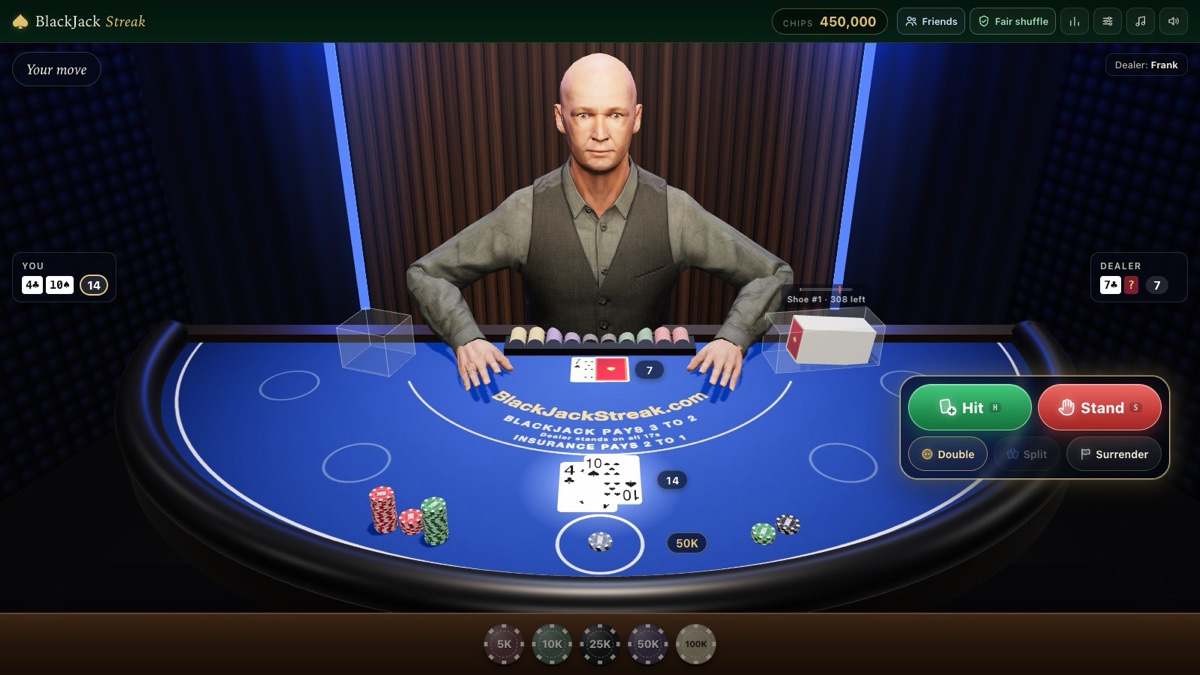
Why does the dealer follow fixed rules?
Because the dealer isn't really a player. The dealer is the house's hands, and the house doesn't need the dealer to think. A fixed rule does three useful things:
- It keeps the game honest and predictable. A dealer who could choose would be a dealer who could choose against you. With a fixed rule, every player at the table faces the same dealer.
- It makes the math exact. Because the dealer's play never changes, the casino knows its edge to a fraction of a percent, and so can you. That's what makes a basic strategy chart possible at all.
- It takes the dealer out of the argument. Nobody can blame the dealer for "hitting into" their hand. The rule did it.
The real source of the house edge: you go first
Here's the part most players never think about. If the dealer's rules are so mechanical, where does the house's advantage come from?
It comes from the order of play. You act first. If you bust, your bet is gone right then, before the dealer turns over the hole card. If the dealer later busts too, it doesn't matter. You already lost.
We measured how much that's worth. We played 2 million rounds through BlackJack Streak's own rules engine with a player who copied the dealer exactly: hit to 17, never double, never split, never surrender. Same rules as the dealer, same cards, plus the 3 to 2 bonus on blackjack. That player still faced a house edge of 5.6%. The only thing working against them was going first.
Everything a good player does, doubling, splitting, standing on a stiff hand against a weak dealer card, is a way of fighting back against that one built-in disadvantage. Do it all correctly and the edge drops to about 0.38% at BlackJack Streak's default rules. Our guide to blackjack odds and the house edge has the full numbers.
Soft 17: stand or hit?
A soft 17 is weak. It can't bust on the next card, but 17 is the lowest total the dealer is allowed to finish on. When the dealer hits soft 17, the dealer gets a free chance to improve to 18, 19, 20 or 21, with no risk of busting on that card. Some of those draws do end in a bust later, but the improvements win out.
The result: a dealer who hits soft 17 costs you about 0.2% of every bet. The Wizard of Odds puts it at 0.22%, and our own simulations measured about 0.17%. That sounds tiny, but it's more than half of the whole house edge of a good game. When you have the choice, pick the table that says dealer stands on all 17s.
H17 also changes a few plays in basic strategy, such as doubling 11 against an ace and surrendering 15 against an ace. Our basic strategy guide lists them.
How often does the dealer bust?
This is the table that explains half of basic strategy. These are the exact chances that the dealer busts, by upcard, with six decks and given that the dealer doesn't have blackjack:
| Dealer upcard | Busts (stands on soft 17) | Busts (hits soft 17) |
|---|---|---|
| 2 | 35.4% | 35.7% |
| 3 | 37.4% | 37.7% |
| 4 | 39.6% | 39.8% |
| 5 | 41.8% | 42.0% |
| 6 | 42.3% | 43.9% |
| 7 | 26.2% | 26.2% |
| 8 | 24.4% | 24.4% |
| 9 | 22.9% | 22.9% |
| 10 | 23.0% | 23.0% |
| Ace | 16.7% | 20.1% |
Two things jump out. First, there's a cliff between 6 and 7. With a 4, 5 or 6 showing, the dealer busts around 40% of the time, so you can often stand on a stiff hand and let the dealer do the work. With a 7 or higher, the dealer usually makes a hand, so you need to improve yours.
Second, hitting soft 17 only changes the 6 and the ace. Those are the only upcards that can turn into a soft 17. With an ace up, the H17 dealer busts more often (20.1% against 16.7%), yet still comes out ahead, because the same rule turns a lot of weak 17s into strong 18s through 21s.
And remember the other side of it: the dealer has to hit 16 even when that's a bad idea. Hitting a hard 16 busts about 62% of the time, a hard 15 about 54%, a hard 12 about 31%.
The peek: why the dealer checks for blackjack
In most American-style games the dealer takes a second card face down, the hole card. When the upcard is an ace or a ten-value card, the dealer peeks at the hole card before anyone plays. If it makes blackjack, the hand ends right there.
The peek protects you. If the dealer has blackjack, you lose only your original bet (or push, if you have blackjack too). You never get the chance to put more money out by doubling or splitting into a hand that was already lost.
With an ace showing, you're offered insurance first. It's a side bet that the dealer has blackjack, and it's almost always a bad one. Frank says so himself: “Ace showing. Insurance? Between you and me, it's usually a sucker bet. But it's your call.” Our guide to blackjack side bets shows the math.
No peek and the European no-hole-card rule
Many European tables deal the dealer only one card until the players have finished. This is often called ENHC, for European no hole card. If the dealer then draws to a blackjack, you can lose not just your original bet but also any extra money you put out to double or split.
According to the Wizard of Odds, that costs the player about 0.10%, mostly through lost doubles. Basic strategy turns more cautious against a dealer 10 or ace under this rule. Some casinos soften it by refunding the extra double and split money, a variation known as "original bets only".
Good to know
Late surrender works hand in hand with the peek. At BlackJack Streak you can surrender (give up half your bet) only after the dealer has checked for blackjack, which is what "late" means.
How the dealer plays at BlackJack Streak
Frank, the dealer at BlackJack Streak, plays by these house rules on every hand:
- Stands on all 17s by default, including soft 17. It's printed on the felt.
- Hits 16 and below, every time.
- Peeks for blackjack under an ace or a ten. With an ace up, he offers insurance (and even money if you hold blackjack) first.
- Never sees your bet. His drawing rule is fixed, and the shuffle never sees bets, balances or decisions. You can check every shoe in the Fair shuffle panel; see how the provably fair shuffle works.
Want to feel the difference soft 17 makes? Open Settings and switch Dealer on soft 17 from Stands to Hits. The setting's own hint says it plainly: "Standing is better for you." Rule changes start with the next hand. At a table with friends, the host sets the rules for everyone.
Frank also narrates his own play. With the sound on (the speaker button at the top), or with captions turned on in Settings, you'll hear lines like “16. I have to hit.” and “I'll stand on 18.” When it goes wrong for him: “Would you look at that, the house goes bust. Don't tell my manager.”
What the dealer's rules mean for your play
- Against 2 through 6, let the dealer take the risk. Stand on hard 13 to 16 (and 12 against 4, 5, 6). Double your 9s, 10s and 11s when the chart says so.
- Against 7 through ace, play to make a hand. The dealer will usually finish on 17 or better, so a 15 or 16 is likely beaten anyway.
- Prefer stands-on-soft-17 tables, and always prefer 3 to 2 over 6 to 5. The 6 to 5 payout costs about 1.4%, far more than any dealer rule.
- Skip insurance. The peek is there to protect your bet, not to sell you a side bet.
New to all of this? Start with how to play blackjack, then come back to the bust table. It will make a lot more sense after a few hands at BlackJack Streak.
Sources
- Blackjack rule variations and their effect on the house edge, Wizard of Odds (dealer hits soft 17, European no hole card, 6 to 5)
- Dealer bust odds: exact calculation for a six-deck shoe with only the upcard removed, given no dealer blackjack
- House edge figures at BlackJack Streak's rules: our own simulations through the game's rules engine (98 million rounds of basic strategy; 2 million rounds copying the dealer)
Questions people ask
Does the dealer have to hit on 16 in blackjack?
Yes. The dealer must hit 16 or less and stand on 17 or more, every time, no matter what the players hold. At BlackJack Streak, Frank follows exactly that rule.
Does the dealer hit on soft 17?
It depends on the table, and the rule is printed on the felt. "Dealer stands on all 17s" is better for you; a dealer who hits soft 17 adds about 0.2% to the house edge. BlackJack Streak stands on all 17s by default, and you can switch it in Settings.
Why does the dealer stand on 17?
It is a fixed house rule, so the dealer never makes choices and every player faces the same dealer. The house does not need the dealer to play well: its edge comes from players acting first and losing when they bust, even if the dealer busts later.
What does it mean when the dealer peeks for blackjack?
With an ace or ten showing, the dealer checks the face-down card before anyone plays. If it makes blackjack, the hand ends and you lose only your original bet, never extra money from doubles or splits.
How often does the dealer bust in blackjack?
About 29 to 30% of hands overall with six decks. It ranges from about 42% with a 5 or 6 showing to about 23% with a 10 and 17% with an ace when the dealer stands on soft 17.