Beginner guide
How Hard Is Blackjack? An Honest Answer, Level by Level
Blackjack has a reputation for being simple, and it is, right up until you want to play it well. The honest answer to "how hard is blackjack?" depends on what you want from it. Learning the rules takes minutes. Playing every hand correctly takes a few weeks of practice. Beating the house over the long run is genuinely hard, and most players never need to try. Here is each level, what it takes, and how to climb them for free at BlackJack Streak.
The short answer
| Level | What it takes | Time | Difficulty |
|---|---|---|---|
| 1. Know the rules | Card values, the goal, five choices | About ten minutes | Easy |
| 2. Play every hand correctly | Basic strategy, learned to the point of habit | A few weeks of regular practice | Moderate |
| 3. Count cards | A running count, a true count, and rules for changing bets and plays | Months of drilling | Hard |
| 4. Beat the house long term | Counting, good rules, a big bankroll, and the patience for huge swings | Years, for very few people | Very hard |
Most people are happy at level 2, and that's the level that matters most. It turns blackjack into one of the closest bets in any casino.
Level 1: The rules take about ten minutes
The whole game fits in a paragraph. You and the dealer each get two cards. You want a total closer to 21 than the dealer's without going over. Number cards count as their face value, face cards count 10, and an ace counts 1 or 11. You can hit, stand, double, split a pair, or surrender. The dealer has no choices at all: hit 16 or less, stand on 17 or more.
That's it. If you can add to 21, you can play. Our step-by-step guide on how to play blackjack walks through a full round, payouts included.
Level 2: Basic strategy takes a few weeks
Basic strategy is the best play for every combination of your hand and the dealer's upcard. Written out as a chart for BlackJack Streak's six-deck rules, it has 280 cells, which sounds like a lot to memorize. It isn't, because most of the chart follows a handful of patterns:
- Stiff hands (12 to 16): stand against a dealer 2 through 6, hit against 7 through ace. The one exception: hit 12 against a 2 or 3.
- Always split aces and eights. Never split tens or fives.
- Double 11 against anything but an ace, and double 10 against 2 through 9.
- Soft 17 or less: never stand. Hit it, or double it against a weak dealer card.
- Surrender 16 against a 9, 10 or ace, and 15 against a 10, when you can.
- Never take insurance.
Learn those and you're right on the large majority of hands. The remaining cells (soft doubles, the odd pair splits) come with practice. Most people get there in a few weeks of short sessions with the chart open beside them, then a few more until they stop needing it. The full chart, cell by cell, is in our basic strategy guide.
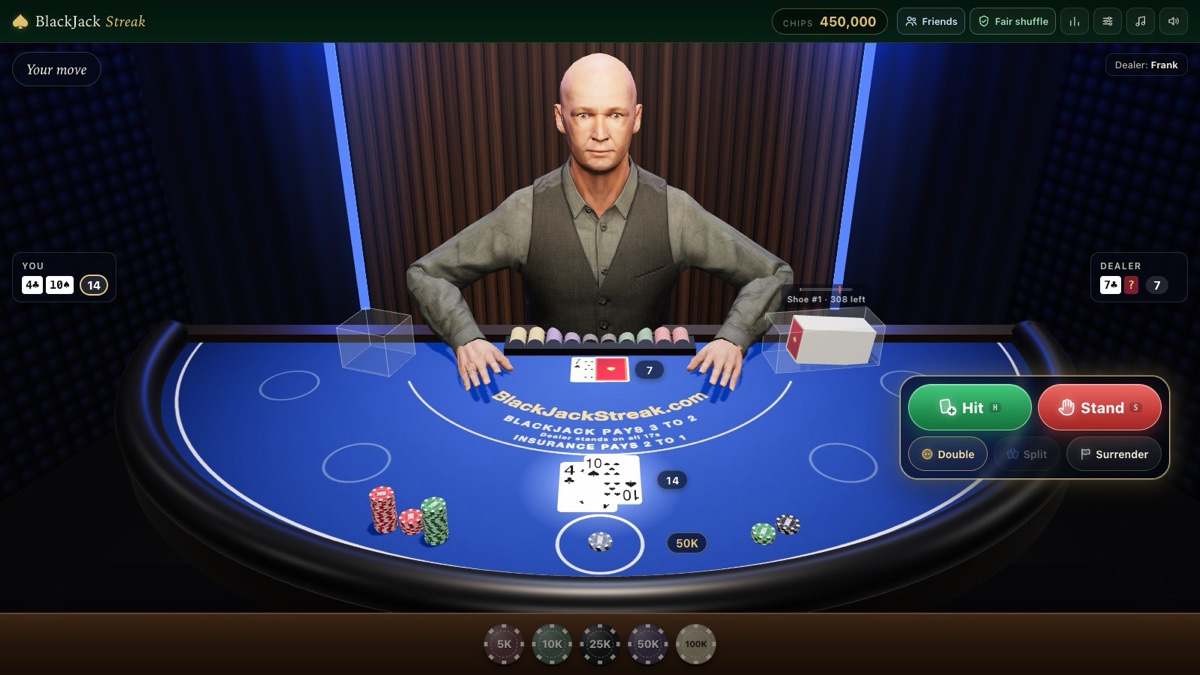
What the skill is worth, in numbers
Here's the part that makes level 2 worth the effort. We played 2 million rounds of each of these strategies through BlackJack Streak's rules engine, at the same rules, from the same kind of shuffled six-deck shoes. Only the decisions changed.
| How you play | House edge (what you lose per bet, on average) | Expected loss betting 10,000 a hand for 100 hands |
|---|---|---|
| Random legal moves | 42.9% | About 429,000 |
| Never risk a bust (stand on hard 12 or more) | 6.05% | About 60,500 |
| Copy the dealer (hit to 17, never double or split) | 5.60% | About 56,000 |
| Perfect basic strategy | About 0.4% | About 4,000 |
The two "sensible" gut strategies people often use cost about fifteen times as much as basic strategy. That's the gap between a game that slowly eats your chips and one that's close to even. A few more habits move the needle too: always taking insurance adds about 0.25% to the house edge, and a table that pays blackjack 6 to 5 instead of 3 to 2 costs you about 1.4%.
Level 3: Card counting is hard
Counting is where blackjack gets genuinely difficult. In the popular Hi-Lo count, low cards (2 to 6) are +1, high cards (10s and aces) are −1, and 7 to 9 count zero. You keep a running total through the shoe, divide it by the decks left to get a true count, and bet more when it's high.
The idea is simple. Doing it fast, silently, while chatting, tracking several hands, and adjusting your plays, without looking like you're doing it, takes months of drilling. Our guide on counting cards online explains the method and how to practice it with a real shoe.
Level 4: Beating the house is very hard
Even perfect basic strategy leaves the house a small edge of about 0.4%. To turn that around you need card counting, favorable rules, a shoe dealt deep enough to matter, and a bankroll large enough to survive swings that would scare most people. Casinos also watch for counters.
And luck dominates the short run no matter how well you play. With perfect strategy you still lose about 49.1% of rounds. In a 1,000-round stretch there's about a one-in-three chance of losing 10 hands in a row somewhere along the way. That's why "is blackjack hard to win?" has a different answer than "is it hard to play well?" Playing well is learnable; winning in any given session is mostly out of your hands. We go deeper on that split in is blackjack luck or skill?
Why blackjack feels harder than it is
The math isn't the hard part. The hard part is that the correct play often feels wrong:
- Hitting 16 against a 10. You'll bust often. Standing is worse, because the dealer usually makes 17 or more.
- Hitting 12 against a 2 or 3, but standing on 12 against a 4.
- Splitting eights against a 10. It turns one terrible hand into two merely bad ones.
- Doubling a soft hand, like ace-six against a 5, when it doesn't look like much.
- Saying no to insurance when the dealer shows an ace and every instinct says protect yourself.
Add a losing streak and the pressure to "try something different" grows. The skill at level 2 is mostly the discipline to make the same play every time. Our beginner tips cover the habits that help.
How to get good at blackjack, free
A plan that works for most people:
- Day one: learn the rules and play a few dozen hands at BlackJack Streak just to get the feel of the table.
- Week one: learn the hard totals (the stiff-hand pattern and the doubles on 9, 10 and 11). Keep the chart open while you play.
- Week two: add pairs and soft hands. Play slowly: Settings has a relaxed deal speed.
- Week three on: close the chart and check yourself after each session.
A few features of BlackJack Streak make this easier. The keyboard shortcuts (H hit, S stand, D double, P split, R surrender) let you play quickly once the decisions are automatic. The stats panel and hand history show how your sessions went. Settings lets you match the rules of a table you plan to visit: 1 to 8 decks, the dealer hitting or standing on soft 17, surrender on or off. And because the chips are free (a free account tops you back up to 500,000), mistakes cost nothing but a lesson.
Frank says
“You play like somebody who reads the rules. I respect that.” Turn the sound on with the speaker button at the top to hear him, or switch on Captions in Settings.
The bottom line
Blackjack is easy to learn, moderately hard to play perfectly, and very hard to beat. The good news is that the moderate level is where almost all the value is: perfect basic strategy cuts the cost of playing from around 6% of every bet to about 0.4%. You can get there in a few weeks, and you can practice every hand of it for free at BlackJack Streak.
Questions people ask
Is blackjack hard to learn?
No. The rules take about ten minutes: get closer to 21 than the dealer without going over, using five choices (hit, stand, double, split, surrender). Playing every hand correctly with basic strategy takes a few weeks of practice.
How long does it take to learn blackjack basic strategy?
Most people learn the main patterns in a week and the full chart in a few weeks of short sessions. Practicing with real six-deck rules at BlackJack Streak, with free chips, is a quick way to make the plays automatic.
Is blackjack hard to win?
In the short run, winning is mostly luck: even perfect play loses about 49% of rounds. In the long run, perfect basic strategy keeps the house edge to about 0.4%, and only skilled card counting under good conditions can beat it.
What is the hardest part of blackjack?
Making the correct play when it feels wrong, like hitting 16 against a 10 or declining insurance, and sticking to it during a losing streak. The math is simple; the discipline is the hard part.
Can a beginner play blackjack for free?
Yes. BlackJack Streak is a free blackjack game in your browser with 500,000 play chips, real casino rules and no real money involved, so beginners can practice every decision without risk.