Blackjack vs other games
Blackjack vs Poker: Which Game Is Easier, Which Takes More Skill, and Which One Suits You
Blackjack and poker both use a 52-card deck and both get called card games of skill, but they are built in opposite ways. In blackjack you play against the house. In poker you play against the people sitting next to you, and the house just takes a cut. That one difference changes everything: how hard the game is to learn, how much skill matters, and how quickly luck evens out. Here is the honest comparison, from the team behind BlackJack Streak.
The one difference that explains all the others
In blackjack, every player at the table is playing the same opponent: the dealer, who represents the house. The dealer follows fixed rules (hit on 16 or less, stand on 17 or more) and makes no choices at all. The house wins because of a small built-in edge, and your decisions decide how small that edge is.
In poker, the house doesn't bet against you. You play against the other players, and the cardroom takes a commission from each pot, called the rake, or charges a seat fee or tournament entry fee. Every chip you win comes out of another player's stack, and every chip you lose goes into one.
So blackjack is a puzzle against a machine that never changes. Poker is a contest against people who are trying to read you while you read them.
Blackjack vs poker at a glance
| Blackjack | Poker (Texas Hold'em) | |
|---|---|---|
| Who you play against | The dealer (the house) | The other players |
| How the house makes money | A built-in house edge on every hand | Rake: usually 2.5% to 10% of each pot, up to a cap, or a fee |
| Can a skilled player win long-term? | Not with basic strategy alone; only with card counting | Yes, if they're better than their opponents by more than the rake |
| Bluffing | None: the dealer can't be fooled | Central to the game |
| Decisions per hand | One to a few, each with a known best answer | Several betting rounds, few clear-cut answers |
| Time to learn the basics | An evening | An evening for the rules, years for the strategy |
| Can you play alone? | Yes, one player vs the dealer | No, you need opponents |
Which is easier to learn?
Blackjack, by a long way. The goal fits in one sentence: beat the dealer's total without going over 21. You have five choices (hit, stand, double, split, surrender), and every situation has one mathematically best play. That set of best plays is called basic strategy, and it fits on a single chart.
Poker's rules are also quick to learn. In Texas Hold'em you get two private cards, five shared cards are dealt to the middle, and the best five-card hand wins. But the rules are the easy part. The hard part is everything around them: when to bet, how much, when to fold a good hand, what your opponent's raise means, and how your own betting looks to them. There is no chart that solves a poker table, because the right play depends on who you're playing.
If you want a fuller answer for blackjack on its own, we wrote a separate guide on how hard blackjack really is.
Which takes more skill?
Poker has the higher skill ceiling. Blackjack has the clearer skill floor.
In blackjack, skill is about avoiding mistakes. A player who follows basic strategy perfectly has done everything the game allows (short of counting cards). We measured how much that matters by running millions of rounds through BlackJack Streak's own rules engine at our default rules:
That is a fourteen-fold difference between a careful player and one who simply copies the dealer. Skill matters enormously in blackjack. It just tops out at "lose very slowly" instead of "win".
In poker, skill is relative. You don't need to be perfect, only better than the people at your table by more than the rake costs you. That is why poker is the casino card game where some players make a living, and also why most players lose: for every winner, the pots have to come from somewhere.
Where card counting fits
Blackjack does have one route to a long-term edge: card counting, which tracks the cards already dealt from the shoe. It is real but demanding, and casinos fight it. Our guide to counting cards online explains how it works and where you can practice it for free.
Which has more luck?
Both games are full of luck in the short run. A single evening of either can go wildly in any direction.
The difference is what luck is up against. In blackjack, luck swings around a fixed house edge. With perfect play you still lose about 49% of rounds and win about 42% (the rest are pushes), and long losing streaks are completely normal. In poker, luck swings around a skill gap between you and your opponents, which is why poker players talk so much about "variance" and need far more hands before the better player reliably comes out ahead.
If you've ever wondered how much of blackjack is luck and how much is you, see is blackjack luck or skill?
Which is better for a group of friends?
This one is closer than you'd think.
- Poker is a social game by design. The table talk, the bluffs and the needling are the point. But it needs at least two players, and a beginner sitting with experienced friends can have a miserable night.
- Blackjack puts everyone on the same side. Nobody at the table is taking your chips; you're all trying to beat the dealer together, so a beginner can sit next to a regular without anyone feeling hunted. It also works when you're on your own.
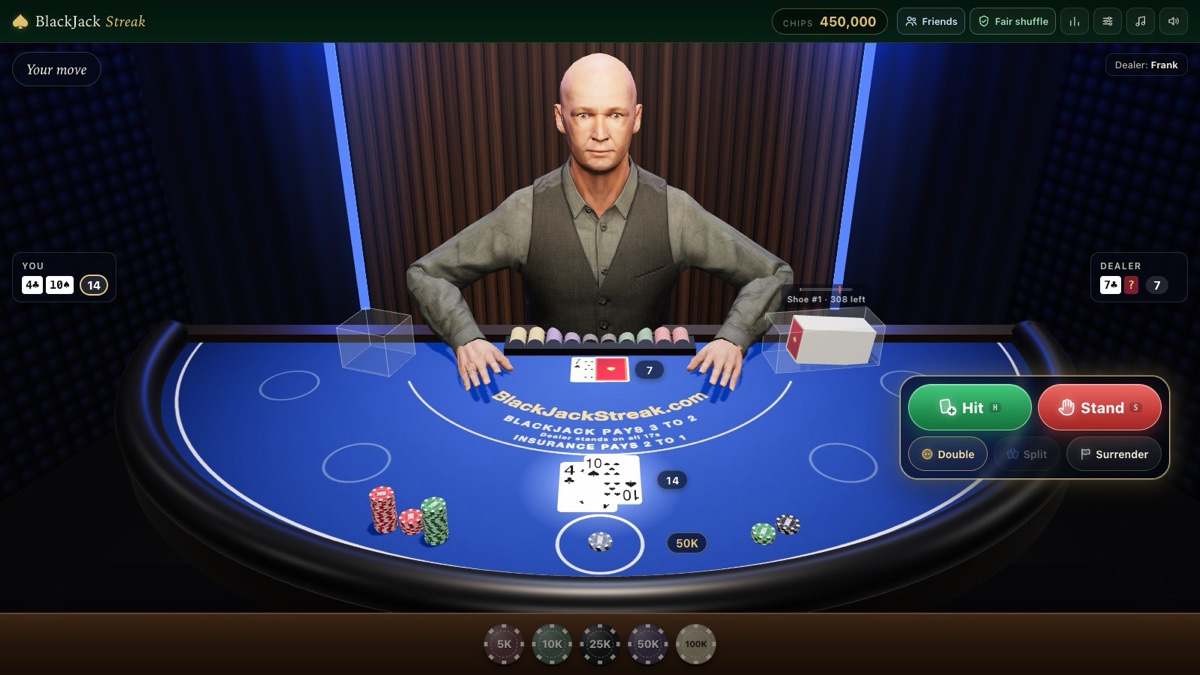
At BlackJack Streak, you can start a free private table and send the link to up to four friends. Everyone plays their own chips against Frank, from one shoe, and no money is involved.
How the house makes money in each
Blackjack: the house edge
The edge comes mainly from one rule: you act first, so if you bust, you lose even if the dealer busts later. At BlackJack Streak's default rules (six decks, dealer stands on soft 17, double after split, late surrender, blackjack pays 3 to 2), the edge against perfect basic strategy is about 0.4%. Worse rules make it worse: a table that pays blackjack at 6 to 5 instead of 3 to 2 costs you about 1.4% more. The full numbers are in our odds and house edge guide.
Poker: the rake
Cardrooms usually take a percentage of each pot, commonly somewhere between 2.5% and 10%, up to a maximum per hand. Higher-stakes games often charge a fixed fee per seat every half hour instead, and tournaments build a house fee into the buy-in. Because the house never plays a hand, the rake is a cost every player has to overcome to win.
Which should you play?
- Pick blackjack if you want a game you can learn tonight and play well tomorrow, you like having a clear right answer, you'd rather not bluff, or you want to play on your own.
- Pick poker if you enjoy reading people, you want a game you can study for years, and you like the idea of competing against players rather than the house.
- Play both if you can. They train different muscles. Blackjack teaches you discipline and probability; poker teaches you patience and psychology.
Whichever you choose, learn it without money on the line first. BlackJack Streak is a free blackjack game, so you can practice every decision with real casino rules and nothing to lose. If you're also weighing up the other table games, read blackjack vs baccarat and blackjack vs roulette, or the Indian favorite in blackjack vs teen patti.
Sources
- Rake (poker), Wikipedia
- House edge of casino games compared, Wizard of Odds
- House-edge figures for BlackJack Streak's rules: our own simulations of millions of rounds through the game's rules engine
Questions people ask
Is blackjack easier than poker?
Yes. Blackjack has a fixed best play for every hand, called basic strategy, that fits on one chart. Poker rules are simple too, but good poker depends on reading opponents and has no chart that solves it. You can learn blackjack in an evening at a free table like BlackJack Streak.
What is the main difference between blackjack and poker?
In blackjack you play against the dealer, who represents the house. In poker you play against other players, and the house takes a commission from each pot called the rake.
Can you make money playing blackjack like you can in poker?
Not with basic strategy alone, because the house keeps a small edge of around 0.4% at good rules. The only long-term route is card counting. In poker, a player who is better than their opponents by more than the rake can win over time.
Which takes more skill, blackjack or poker?
Poker has the higher skill ceiling because you compete against people. Blackjack skill matters a lot too: perfect basic strategy loses about 0.4% of each bet, while playing like the dealer loses about 5.6%.
Can I play blackjack with friends for free?
Yes. BlackJack Streak lets you start a free private table and invite up to four friends with a link. Everyone plays their own play chips against Frank, the dealer, and no money is involved.