Strategy
Blackjack Basic Strategy: The Complete Chart, and Why Every Play Works
Basic strategy is the single best play for every blackjack hand you can be dealt, worked out by computer over millions of hands. Follow it and the house edge at BlackJack Streak's default rules drops to about 0.38%. Below is the complete chart for those rules, how to read it, and the reasoning behind the plays that feel wrong the first time you make them.
What basic strategy is (and what it isn't)
Basic strategy answers one question: given your hand and the dealer's upcard, which play loses the least, or wins the most, over the long run? It doesn't remember earlier cards, it doesn't guess, and it doesn't care how the last ten hands went. Every hand is solved on its own.
It also isn't a way to beat the game. The house keeps a small edge even with perfect play. What the chart does is shrink that edge to almost nothing, which is why it's the first thing every serious player learns.
The rules this chart is for
A strategy chart is built for a specific set of rules. This one matches the default table at BlackJack Streak, which is also a common casino setup:
- Six decks, reshuffled at a cut card 75% of the way through
- Dealer stands on all 17s (often written S17)
- Dealer peeks for blackjack under an ace or a ten
- Double on any two cards, including after a split (DAS)
- Split up to four hands; split aces get one card each
- Late surrender allowed; blackjack pays 3 to 2
If your table differs, a few cells change. The biggest one, a dealer who hits soft 17, gets its own section further down.
How to read the chart
Find your hand down the left side and the dealer's upcard across the top. The cell where they meet is your play. Check in this order, because the order matters:
- Surrender, if it's offered and the chart says R.
- Split, if you hold a pair. Use the pairs chart.
- Double, if the chart says D and you're on your first two cards.
- Hit or stand for everything else.
Doubling and surrender are only allowed on your first two cards. When you can't double, a D means hit and a Ds means stand. When you can't surrender (after a split, or with three or more cards), an R means hit.
H: HitS: StandD: Double, otherwise hitDs: Double, otherwise standP: SplitR: Surrender, otherwise hit
Hard totals
A hard hand has no ace, or an ace that must count as 1. Most of your hands are hard.
| Your hand | 2 | 3 | 4 | 5 | 6 | 7 | 8 | 9 | 10 | A |
|---|---|---|---|---|---|---|---|---|---|---|
| 8 or less | H | H | H | H | H | H | H | H | H | H |
| 9 | H | D | D | D | D | H | H | H | H | H |
| 10 | D | D | D | D | D | D | D | D | H | H |
| 11 | D | D | D | D | D | D | D | D | D | H |
| 12 | H | H | S | S | S | H | H | H | H | H |
| 13 | S | S | S | S | S | H | H | H | H | H |
| 14 | S | S | S | S | S | H | H | H | H | H |
| 15 | S | S | S | S | S | H | H | H | R | H |
| 16 | S | S | S | S | S | H | H | R | R | R |
| 17 or more | S | S | S | S | S | S | S | S | S | S |
The shape of this chart tells the whole story. Against a dealer 2 through 6, you stand on your stiff hands (12 to 16) and let the dealer take the risk of busting. Against a 7 or higher, you keep hitting those same hands, because standing on 15 against a 10 loses far more often than hitting it does.
Hard 12 is the odd one out: hit it against a 2 or 3, stand against 4, 5 and 6. A 12 only busts on a ten-value card, and a dealer 2 or 3 is not weak enough to justify standing.
Soft totals
A soft hand holds an ace counted as 11. One more card can't bust it, so you can afford to be braver.
| Your hand | 2 | 3 | 4 | 5 | 6 | 7 | 8 | 9 | 10 | A |
|---|---|---|---|---|---|---|---|---|---|---|
| A,2 (soft 13) | H | H | H | D | D | H | H | H | H | H |
| A,3 (soft 14) | H | H | H | D | D | H | H | H | H | H |
| A,4 (soft 15) | H | H | D | D | D | H | H | H | H | H |
| A,5 (soft 16) | H | H | D | D | D | H | H | H | H | H |
| A,6 (soft 17) | H | D | D | D | D | H | H | H | H | H |
| A,7 (soft 18) | S | Ds | Ds | Ds | Ds | S | S | H | H | H |
| A,8 (soft 19) | S | S | S | S | S | S | S | S | S | S |
| A,9 (soft 20) | S | S | S | S | S | S | S | S | S | S |
Soft hands are where most players leave value on the table. A,6 is not a good 17: it's a weak hand that the dealer beats often, so you double it against 3 through 6 and hit it otherwise. Never stand on soft 17.
A,7 (soft 18) is the trickiest row. Double against 3 through 6 if you can (stand if you can't), stand against 2, 7 and 8, and hit against 9, 10 and an ace. Eighteen sounds strong, but a dealer 9, 10 or ace makes 19 or better often enough that drawing again is the better bet.
Pairs
Use this chart first whenever your two cards match. Ten-value cards count as a pair of tens for this purpose.
| Your pair | 2 | 3 | 4 | 5 | 6 | 7 | 8 | 9 | 10 | A |
|---|---|---|---|---|---|---|---|---|---|---|
| 2,2 | P | P | P | P | P | P | H | H | H | H |
| 3,3 | P | P | P | P | P | P | H | H | H | H |
| 4,4 | H | H | H | P | P | H | H | H | H | H |
| 5,5 | D | D | D | D | D | D | D | D | H | H |
| 6,6 | P | P | P | P | P | H | H | H | H | H |
| 7,7 | P | P | P | P | P | P | H | H | H | H |
| 8,8 | P | P | P | P | P | P | P | P | P | P |
| 9,9 | P | P | P | P | P | S | P | P | S | S |
| 10,10 | S | S | S | S | S | S | S | S | S | S |
| A,A | P | P | P | P | P | P | P | P | P | P |
Two rows to tattoo on your memory: always split aces and eights, and never split tens or fives. A pair of eights is 16, the worst hand in the game, while two hands starting with 8 each are respectable. A pair of fives is a 10, one of the best doubling hands there is, so play it as a 10.
Nines are the row people get wrong: split against 2 to 6, 8 and 9, but stand against a 7 (your 18 already beats the dealer's likely 17) and against a 10 or ace.
Frank says
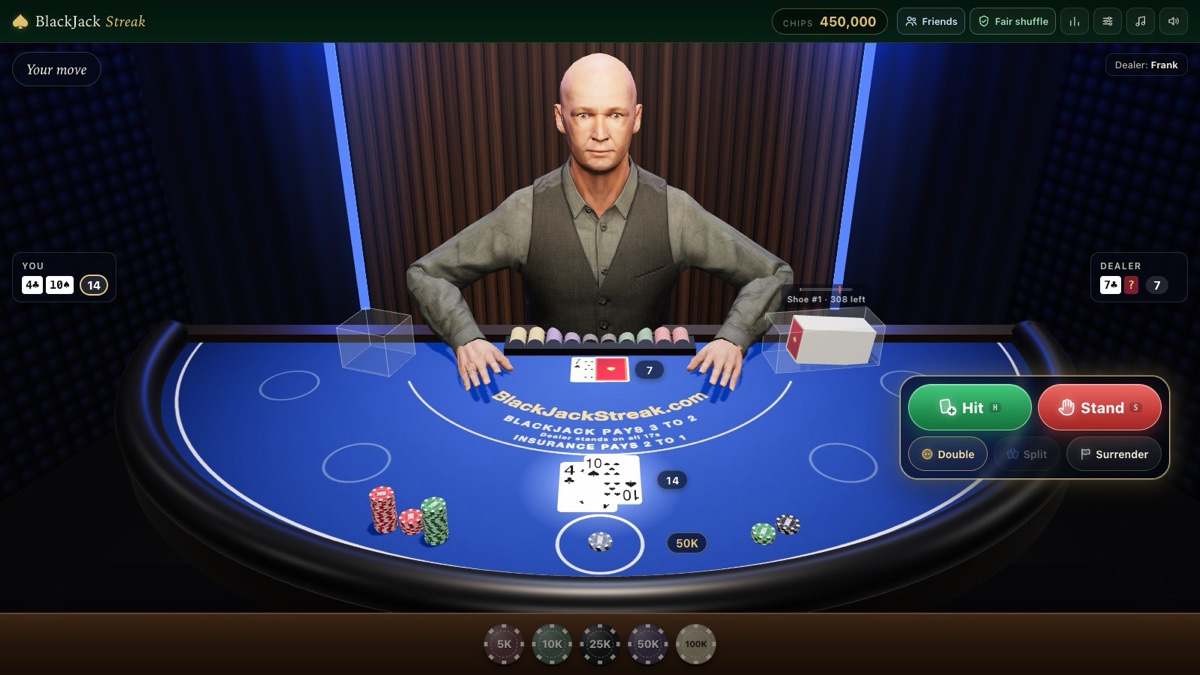
“Strategy tip from Frank: always split aces and eights. Never split tens. Trust me, I’ve seen the tears.”
The logic behind the plays
You don't need to memorize reasons to use the chart, but the reasons make it stick. Almost every cell comes back to one fact: how often the dealer busts depends on the upcard. With a six-deck shoe and a dealer who stands on soft 17, the dealer busts about 42% of the time with a 6 showing, and only about 23% of the time with a 10 showing.
So when the dealer is weak, you avoid busting yourself and double your strongest starts. When the dealer is strong, you accept the risk of hitting, because a stiff hand that stands will usually lose anyway. The full numbers for every upcard are in our guide to blackjack odds and the house edge.
Ten plays to learn first
If the whole chart feels like a lot, start here. These ten cover most of the value:
- Always split aces and eights.
- Never split tens or fives.
- Double 11 against everything except an ace.
- Double 10 against 2 through 9.
- Stand on 13 to 16 against 2 through 6.
- Hit 12 to 16 against 7 through ace.
- Stand on 12 only against 4, 5 and 6.
- Never stand on soft 17; double it against 3 through 6.
- Surrender 16 against 9, 10 and ace, and 15 against 10, when surrender is offered.
- Decline insurance.
When the dealer hits soft 17
Some tables make the dealer hit a soft 17 (written H17). That helps the house, so a handful of plays get more aggressive to fight back:
- Double 11 against an ace, instead of hitting.
- Double A,7 (soft 18) against a 2, instead of standing.
- Double A,8 (soft 19) against a 6, instead of standing.
- Surrender hard 15 and hard 17 against an ace.
Everything else stays the same. The rule change itself costs you: in our simulation through BlackJack Streak's own rules engine, perfect basic strategy faced a house edge of 0.38% with the dealer standing on soft 17 (98 million rounds) and 0.55% with the dealer hitting it (40 million rounds). You can switch between the two in BlackJack Streak's Settings and feel the difference for yourself.
How to practice basic strategy at BlackJack Streak
Reading a chart and playing it under a little pressure are different skills. The fastest way to close the gap is volume, and BlackJack Streak is built for it:
- Keyboard play. Press
Spaceto deal (it repeats your last bet), thenH,S,D,PorR. Your hands never leave the keys. - Deal speed. Set it to Fast in Settings once the plays feel natural.
- Free chips. You start with 500,000 play chips, so a bad shoe costs nothing but pride.
- Quiet mode. Set how much Frank talks to Quiet when you want to focus, or Chatty when you want company.
- Rule switches. Change decks, soft 17 and surrender in Settings to practice the variations above.
Keep the chart open in another tab for your first sessions, then try a shoe without it. If you're brand new, start with how to play blackjack, and when the chart is second nature, card counting is the next step up.
What basic strategy can't do
Perfect basic strategy still loses a little over time, and it can lose a lot in a short run. Losing five rounds in a row is normal, not a sign that something is wrong. The chart makes every decision as good as it can be; it can't choose the cards. That's also why BlackJack Streak publishes a fingerprint of every shoe before it's dealt, so you never have to wonder whether a bad run was bad luck.
Questions people ask
What is blackjack basic strategy?
Basic strategy is the mathematically best play for every combination of your hand and the dealer's upcard, calculated by computer. It tells you when to hit, stand, double, split or surrender, and it cuts the house edge to about 0.38% at BlackJack Streak's default six-deck rules.
Should you hit or stand on 16 against a 10?
Surrender if the table allows it, and hit if it doesn't. Standing on 16 against a dealer 10 loses more often, because the dealer only busts about 23% of the time with a 10 showing.
Does basic strategy guarantee a win in blackjack?
No. It makes every decision as good as possible, but the house keeps a small edge and short-term losing streaks are normal. It is the best you can do without counting cards.
What changes in basic strategy when the dealer hits soft 17?
You double 11 against an ace, double soft 18 against a 2, double soft 19 against a 6, and surrender hard 15 and hard 17 against an ace. Everything else stays the same.
Where can I practice basic strategy for free?
BlackJack Streak is a free blackjack game in your browser with the same six-deck rules this chart is built for. You start with 500,000 play chips, there is nothing to buy, and keyboard shortcuts let you drill hands quickly.