Fairness
Is Online Blackjack Rigged? How to Tell, and How to Check a Shuffle Yourself
If you've ever lost eight hands in a row online and wondered whether the game was cheating, you're in good company. It's a fair question, and the honest answer depends on where you're playing. This guide covers how different kinds of blackjack sites deal their cards, the red flags worth knowing, the math of streaks that feel rigged but aren't, and how BlackJack Streak lets you check every shoe for yourself.
The short answer
It depends on what kind of site you're on:
- Licensed real-money casinos in regulated markets have to use random number generators that independent testing labs check as a condition of their license. Cheating would risk the license, and they don't need to: the house edge already does the work for them, slowly and legally.
- Free and "social" blackjack apps are a different world. Because no real money can be won, they usually aren't regulated as gambling at all, nobody independent tests their shuffle, and many of them earn their money by selling coins. You have no way to know how the cards are chosen.
- Unlicensed sites offer no protection of any kind. If one of them takes real money, treat it as a risk, whatever its games look like.
The common thread: on almost every site, you're asked to trust the operator. Very few let you check.
Why an honest house still wins
A lot of "rigged" feelings are really the house edge at work. Blackjack is one of the fairest games in a casino, but it isn't even. Players bust first, and a bust loses even if the dealer busts later. That one rule tilts the game toward the house.
We measured it. We played 98 million rounds of perfect basic strategy through BlackJack Streak's own rules engine, at its default rules (six decks, blackjack pays 3 to 2, the dealer stands on soft 17, late surrender):
You lose more rounds than you win, even playing perfectly. Blackjacks paying 3 to 2 and well-timed doubles claw most of it back, which is why the edge ends up so small. Change the rules and it grows: when the dealer hits soft 17, our simulation put the edge at 0.55%, and a table paying 6 to 5 for blackjack costs you about another 1.4% of every bet. Imperfect play adds more. Our guide to blackjack odds and the house edge has the full numbers.
Why a fair game feels rigged: streaks
Here's the part that fools almost everyone. Losing streaks in blackjack are not rare. They're normal, and they're longer than intuition expects.
Using the loss, win and push rates from that simulation, we calculated how likely you are to hit a streak of losses at some point, playing perfect strategy (a push breaks a streak):
| Losing streak | Chance it happens in 100 rounds | Chance it happens in 500 rounds |
|---|---|---|
| 5 or more in a row | 78% | Almost certain |
| 6 or more in a row | 51% | 98% |
| 7 or more in a row | 29% | 83% |
| 8 or more in a row | 15% | 58% |
| 10 or more in a row | 4% | 19% |
So in an evening of 100 hands, you'll more likely than not lose six in a row somewhere, even if you never make a mistake. Play 500 hands and a seven-hand losing run is close to a sure thing. Winning streaks happen too (five wins in a row shows up in 55% of 100-round sessions), but they're rarer, because you win fewer rounds than you lose.
Our memories don't help. A bad run sticks; the long, boring middle doesn't. Ten losses in a row feels like proof. Usually it's just Tuesday.
Frank says
“Losing streaks end. That’s just math. Hang in there.”
Red flags worth taking seriously
None of these prove a game is rigged. But each one means you're being asked for trust without being given a way to check:
- It sells chips, and nudges you to buy after a losing run. A game that profits when you run out of chips has a reason to care when you do.
- The rules aren't stated. If you can't find how many decks are used, whether the dealer hits soft 17, or what blackjack pays, the game is hiding the things that set your odds.
- Nothing explains the shuffle. "Certified random" with no detail is a slogan, not evidence.
- It takes real money without a license you can look up. No regulator means nobody to complain to.
- Ads promise easy winnings. Blackjack has a house edge. Anyone promising otherwise is selling something.
And one thing that is not a red flag: a long losing streak on its own. See the table above.
What "provably fair" means
Provably fair is a way of dealing cards so you don't have to trust the dealer. Think of it as a sealed envelope:
- Before the cards are shuffled, the dealer writes down a secret number, seals it in an envelope, and shows you the envelope. (In practice: it publishes a cryptographic fingerprint of a secret seed.)
- You add a secret number of your own, which the dealer can't know in advance.
- The shuffle uses both numbers together, by a public method, so neither side controls the result.
- Afterwards, the envelope is opened. You check it matches what was sealed, redo the shuffle yourself, and confirm every card came out in exactly that order.
If the dealer changed anything after sealing the envelope, the fingerprint wouldn't match. If the dealer tried to pick a seed that produces a bad shoe for you, your own seed would scramble it. That's the whole idea. We explain it in more depth on our provably fair blackjack page.
How BlackJack Streak lets you check every shoe
BlackJack Streak exists because the person who built it didn't trust the shuffles at paid online card sites, and wanted a game where nobody has to take anyone's word for it. So every shoe works like this:
- The dealer commits first. Before a shoe is shuffled, the server draws a secret 256-bit seed from its cryptographic random generator and publishes its SHA-256 fingerprint. You can see it in the Fair shuffle panel (the shield at the top) before a single card is dealt.
- You add a seed. Your browser makes its own random seed and sends it in, and so does everyone else at the table. The server can't know them when it commits.
- A fair algorithm. The shoe is a Fisher-Yates shuffle driven by SHA-256 of all the seeds together, built so every possible order is exactly as likely as any other. Cards then come strictly off the top.
- Opened afterwards. When the shoe is retired, the panel reveals the dealer's seed, checks it against the fingerprint, recomputes the whole order, and confirms that every card you saw came off the top in that order, with your seed included.
- Test the shuffler yourself. The panel can run 100,000 shuffles on the spot and chart where the ace of spades lands. A fair shuffle spreads it evenly across every position.
Two more things matter. Frank's face-down card is never sent to your browser until it's turned over, so nobody can peek at it. And the shuffle never sees bets, balances or decisions, so it can't “know” you just bet big.
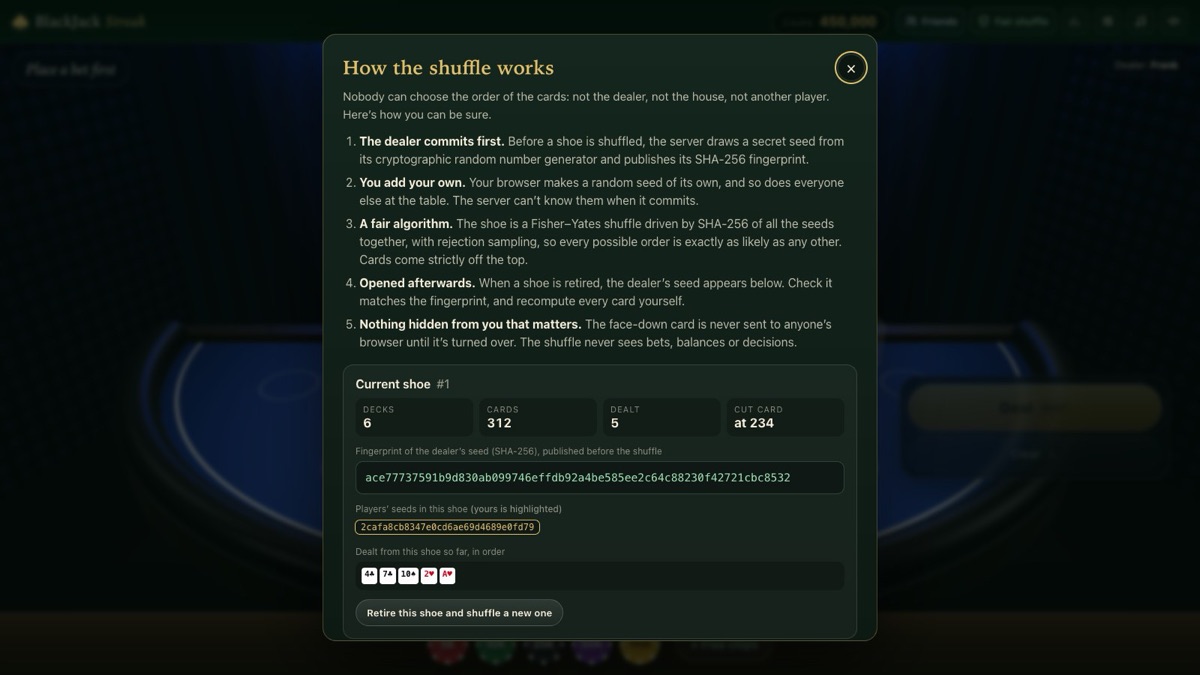
Don't want to wait for the cut card? At your own table you can retire the shoe from the same panel and check it straight away.
Why we have no reason to rig it
BlackJack Streak is played with free chips only. There are no deposits, no chips for sale, no cash prizes and no ads. When you run low, a free account tops you back up to 500,000. We don't make a cent from your losing streak, and even if we wanted to rig a shoe, the commit-and-reveal design means we couldn't do it without the proof failing in front of you.
Frank puts it best:
“If you ever wonder whether I'm rigging the cards, click that little shield up top. It's the proof. I've got nothing to hide but my bald spot.”
If you do play for real money somewhere
BlackJack Streak is play money, and we'd encourage anyone to keep blackjack that way. If you choose to play real-money blackjack where it's legal for you, a few habits help:
- Play only at sites licensed by a regulator you can look up, and check the license yourself.
- Read the table rules before you sit down. 3 to 2 blackjack and a dealer who stands on soft 17 are worth looking for.
- Learn basic strategy first, on free tables, so the house edge stays small.
- Set a limit before you start and stop when you reach it. As Frank says: “If you ever play somewhere that sells you chips, set a limit and walk away when you hit it.”
Looking for a free table you can trust? We compared the options in the best free blackjack sites.
Questions people ask
Is online blackjack rigged?
Licensed real-money casinos in regulated markets must use independently tested random number generators, and the house edge already favors them. Free apps are usually unregulated and untested, so you cannot know. BlackJack Streak is different: it publishes a sealed fingerprint of every shoe before dealing and lets you check the whole order afterwards.
Are free blackjack apps rigged?
There is usually no way to tell, because free apps are rarely tested independently and many make money by selling coins. Look for a provably fair game, like BlackJack Streak, where you can verify the shuffle yourself.
Why do I keep losing at online blackjack?
Even with perfect basic strategy you lose about 49% of rounds and win about 42%, with the rest pushing. In 100 rounds of perfect play, a run of five or more losses happens about 78% of the time, so long losing streaks are normal and not proof of cheating.
What does provably fair blackjack mean?
It means the dealer commits to a secret seed with a public fingerprint before shuffling, players add their own seeds, and the seed is revealed afterwards so anyone can recompute the shuffle and confirm every card came out in that order.
How can I check that BlackJack Streak is fair?
Click the shield at the top of the table to open the Fair shuffle panel. It shows the sealed fingerprint before the shoe is dealt, your own seed, and every card dealt; when the shoe is retired it reveals the seed, recomputes the order and confirms it matches. It can also run 100,000 test shuffles on the spot.