Rules
Blackjack Side Bets Explained: Perfect Pairs, 21+3, Insurance, and Why They Cost So Much
Sit at almost any casino blackjack table today and you'll see extra betting spots: Perfect Pairs, 21+3, Lucky Ladies, a bonus for the dealer busting. They promise big payouts for a small extra chip. Here is how each one works, what it really costs you compared with blackjack itself, and why BlackJack Streak only offers insurance, and tells you not to take it.
What is a blackjack side bet?
A side bet is an optional wager placed next to your main bet before the cards are dealt. It pays on something specific, usually your first two cards, sometimes with the dealer's upcard, or on how the dealer's hand ends. Your blackjack hand plays on as normal; the side bet is settled on its own.
The appeal is easy to see: 25 to 1, 100 to 1, even 1,000 to 1. The problem is just as easy to state. Every common side bet has a much bigger house edge than blackjack itself, and no decision you make can lower it.
The main game sets the bar
Blackjack played well is one of the best bets in a casino. At BlackJack Streak's default rules (six decks, dealer stands on soft 17, 3 to 2 blackjack, double after split, late surrender), perfect basic strategy faces a house edge of about 0.38%. We measured that over 98 million simulated rounds through the game's own rules engine.
Keep that number in mind. Every side bet below is measured against it.
The common side bets, one by one
Perfect Pairs
Wins if your first two cards are a pair. It usually pays in three tiers: a mixed pair (one red, one black, like the 8 of hearts and 8 of clubs), a colored pair (same color, different suits) and a perfect pair (identical cards, possible because a shoe holds several decks).
A typical pay table is 25 to 1 for a perfect pair, 12 to 1 for a colored pair and 6 to 1 for a mixed pair. According to the Wizard of Odds, the house edge with six decks ranges from about 4.2% to 10% depending on the pay table, and it gets worse with fewer decks, because identical cards become rarer.
21+3
Your two cards plus the dealer's upcard make a three-card poker hand. It pays on a flush, straight, three of a kind or straight flush. Some versions pay a flat 9 to 1 for any of them; others scale up to 100 to 1 for suited three of a kind.
The Wizard of Odds lists six-deck house edges from about 3% for flat-pay versions like 9 to 1 on everything to 13.4% for a version called 21+3 Xtreme, with many common tables in between.
Lucky Ladies
Pays when your first two cards total 20, with bigger payouts for suited 20s, matched 20s and a pair of queens of hearts, and a top prize (often 1,000 to 1) for the queen-of-hearts pair when the dealer also has blackjack.
This one swings wildly by pay table. The Wizard of Odds puts six-deck versions anywhere from about 5.9% to 24.7%, and he has called the original version a sucker bet.
Buster Blackjack
Pays when the dealer busts, and pays more the more cards the dealer needed to get there: typically 250 to 1 for a bust with eight or more cards, and more in some versions if you also hold blackjack. It's the one side bet that roots for the same thing you do.
Common versions run at a house edge of about 6.2%, according to the Wizard of Odds, with some variants as high as 13.8%.
| Bet | Wins when | Top payout (typical) | House edge (six decks) |
|---|---|---|---|
| Blackjack, basic strategy | Your hand beats the dealer's | 3 to 2 | about 0.38% |
| Perfect Pairs | Your first two cards are a pair | 25 to 1 or 30 to 1 | about 4.2% to 10% |
| 21+3 | Your cards plus the upcard make a poker hand | 9 to 1 flat, or 100 to 1 | about 3% to 13.4% |
| Lucky Ladies | Your first two cards total 20 | 1,000 to 1 | about 5.9% to 24.7% |
| Buster Blackjack | The dealer busts | 250 to 1 | about 6.2% (variants to 13.8%) |
| Insurance | The dealer has blackjack | 2 to 1 | about 7.4% |
Pay tables vary from casino to casino, so these are ranges, not promises. The pattern doesn't change: the side bet always costs many times more than the hand next to it.
What that difference means in chips
Say you bet 10,000 on your hand and another 10,000 on a side bet with a 6% house edge. Over time, the blackjack bet costs you about 38 chips a hand. The side bet costs you about 600. The small extra chip is doing about sixteen times the damage of the game you came to play.
That's why side bets exist. They're simple to deal, they make the table feel exciting, and they move the house edge from fractions of a percent into whole numbers.
Insurance: the side bet every table offers
When the dealer shows an ace, you'll be offered insurance: a side bet of up to half your stake that the dealer's hole card is a ten, giving the dealer blackjack. It pays 2 to 1.
The math against it is short. From a fresh six-deck shoe with the dealer's ace removed, 96 of the 311 unseen cards are tens: about 30.9%. To break even at 2 to 1, you'd need tens a third of the time. You win 2 units 30.9% of the time and lose 1 unit 69.1% of the time, so insurance loses about 7.4% of what you put on it.
We tested it in practice too. Over 2 million simulated rounds at BlackJack Streak's rules, a player who always took insurance gave up about 0.25% of every starting bet on top of the normal house edge. That's an extra cost of more than half the whole game's edge, for a bet that only comes up when the dealer shows an ace.
Even money is the same bet in disguise. When you hold blackjack against a dealer ace, taking even money is exactly the same as insuring your blackjack. It feels safe, but the insurance inside it carries the same 7.4% house edge.
The one exception
Insurance becomes a good bet when more than a third of the cards left are tens. Card counters track exactly that, which is why insurance is one of the first decisions a count changes. Our guide to card counting online explains how.
Frank, BlackJack Streak's dealer, is honest about it. With an ace up, he'll say: “Ace showing. Insurance? Between you and me, it's usually a sucker bet. But it's your call.”
Why BlackJack Streak has no side bets
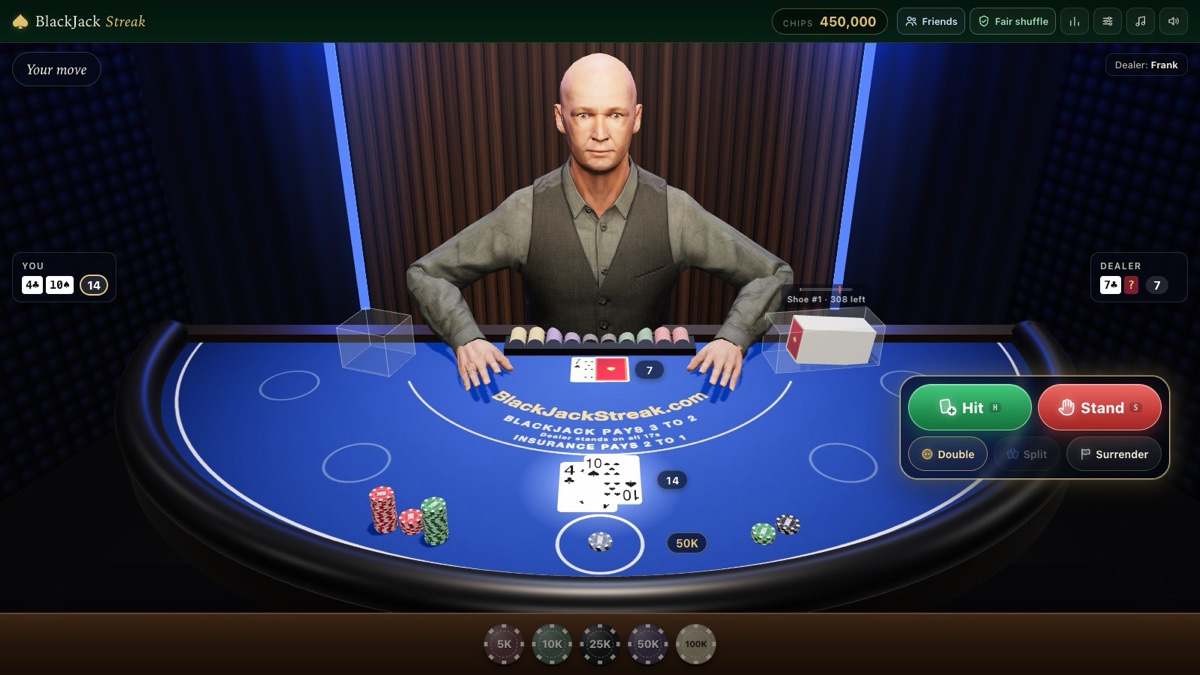
We left them out on purpose. BlackJack Streak is built around the part of blackjack where your decisions count: hit, stand, double, split, surrender. Side bets have no decisions in them. They are pure house edge with a bright pay table on top.
- It keeps the game honest. The rules on the felt are the whole game. Nothing on the table exists to drain your chips faster.
- It keeps your practice useful. If you play here to learn basic strategy, every chip you win or lose comes from the decisions you're practicing.
- There's nothing to sell you. Chips are free, there's no shop and no ads, so there's no reason to make you run out. See free blackjack at BlackJack Streak.
Insurance stays because it's part of standard blackjack and you'll meet it at every real table. Practicing saying no is useful.
If you play side bets anyway
Side bets aren't evil, they're just expensive entertainment. If you're at a real table and want to play one:
- Read the pay table. The same name can hide very different edges. A 9 to 1 flat 21+3 is a far better bet than a version with a flashy 100 to 1 on top.
- Keep it small. A side bet a fraction of your main bet limits the damage.
- Never use it to chase. Losing streaks are normal in blackjack; see how long a losing streak can run. A long-shot side bet won't fix one.
Or skip them, and spend your chips where the odds are best: on your hand, played well.
Sources
- Perfect Pairs, Wizard of Odds (pay tables and house edge by number of decks)
- 21+3, Wizard of Odds (pay tables and house edge by number of decks)
- Lucky Ladies, Wizard of Odds
- Buster Blackjack, Wizard of Odds
- Lucky Ladies question of the day, Las Vegas Advisor
- Insurance: exact calculation from a fresh six-deck shoe; house edge and insurance cost at BlackJack Streak's rules from our own simulations through the game's rules engine
Questions people ask
Are blackjack side bets worth it?
Not mathematically. Common side bets like Perfect Pairs, 21+3, Lucky Ladies and Buster Blackjack carry house edges of roughly 3% to 25%, against about 0.38% for the main game played with basic strategy.
What is the Perfect Pairs side bet?
It pays if your first two cards are a pair, with higher payouts for colored pairs and identical perfect pairs, often 25 to 1. With six decks its house edge is about 4% to 10% depending on the pay table.
What is 21+3 in blackjack?
A side bet that treats your two cards plus the dealer's upcard as a three-card poker hand, paying on flushes, straights, three of a kind and straight flushes. Six-deck versions run from about 3% to 13.4% house edge.
Should you take insurance in blackjack?
Almost never. From a fresh six-deck shoe only about 30.9% of the unseen cards are tens, so insurance loses about 7.4% of what you bet on it. Only a card counter who knows the shoe is rich in tens should take it.
Does BlackJack Streak have side bets?
No, only insurance, which is part of standard blackjack. BlackJack Streak leaves side bets out on purpose so every chip you win or lose comes from your own decisions in the main game.